
A Ghost of Power

Greetings, everyone!
In lieu of the flu which I had this week, I’ve decided it wise to take a little break from the Isolation Chronicle. I always like to have a little time to sit with, revise, and find an appropriate quote and image for each chapter. Furthermore, the previous chapter—Chapter 11: The Pool & the Picture—spurred my memory of a chapter that I wrote much later that had not yet been placed in the larger work. After digging through my notebooks and reading it over, it would seem to slot in very well as the next chapter but still needs a bit of polishing and additional work.
In the meantime, here is a short story I wrote after I had done the bulk of the work on the IC—previously published elsewhere—as I felt a need to try my moving hand at writting [sic] some more traditional storytelling. Indeed, this story works best in that oldest of storytelling traditions: oral. It’s an untold branch of perhaps one of the world’s most famous tales, one routed in both fact and fiction, in myth and reality, in its reflection of human activity both past and present, and thus not at all at odds with the overarching themes of the Isolation Chronicle.
So without further ado …
- DH
A Ghost of Power
by Daniel Hagen
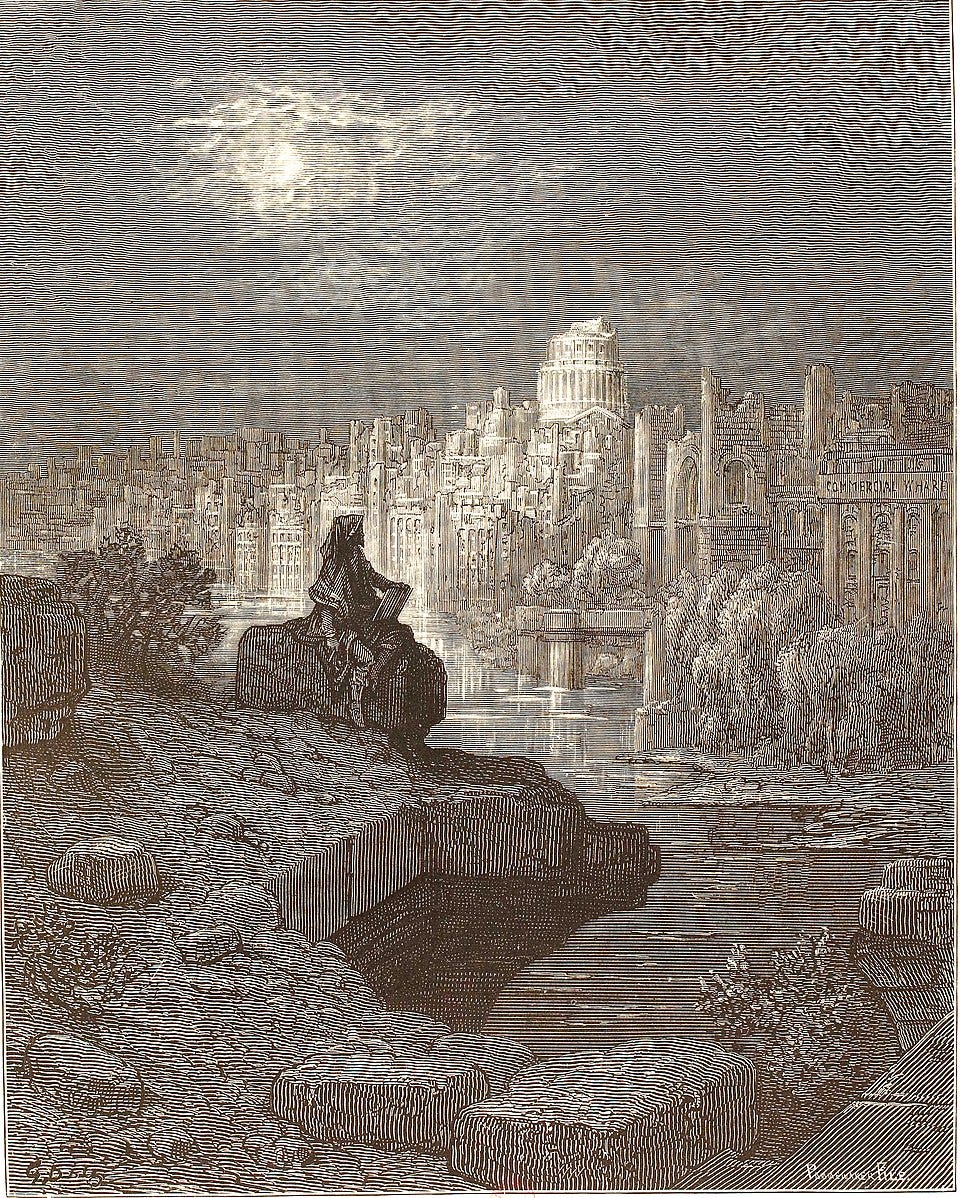
Of all the tragedies we had suffered in those long years, our self-deception was the greatest cause of our misfortune. We opened the gates. We accepted their gift. Had we really been so stupid to think, after they had sat upon our doorstep for so long, on the morning we awoke to find their armies and ships gone, with only the remains of their smoldering decampment attesting to their previous presence, that it was really and truly over? How quickly, in the absence of any clear danger, we fall into the trap betokened by a sigh of relief.
For many years after, I had thought of myself as a coward, that I should have fought and died alongside my countrymen, but something hadn’t sat right with me that night. Something fluttered noiselessly in my breast at the absence of our enemies. I had grown up into my prime, after all, within their ever-present shadow. For all the children of our besieged city, their presence had become as eternal as the waters and beaches upon which they perched. We grew up secure in the knowledge that death could be upon us at any moment: during our lessons; while at play; in the course of an evening meal with our families; asleep in our beds …
After all that time—most of my life!—I could not believe that they were gone. But I was barely a man myself then—an infant of a man … and thus I commanded little respect from my peers, much less my superiors. But for that peculiar fluttering, I would have joined in the celebrations. However, I drank tepidly, in trepidation at the sight of that ominous nag.
Did I know they were inside? No, I had no sense of the particulars of the danger, only that some dull sensory perception warned me to be on my guard. That was the extent of my knowledge and wisdom; it was enough to feel a tension in my being, but not enough to know how to put it to words, or convince anyone else of such an unnamable threat. I remarked to one of my company how strange it was that everyone could make merry so unconcernedly after having lived in fear for so long. He grabbed me roughly at the neck, shoved me away, and told me to shut up and drink. He laughed —mirthlessly, I thought—and turned to find cheerier company. I never saw him again.
I retired early and alone to my room in the upper quarters of the city. Unable to sleep, I lay upon my bed listening to the ongoing revelry. Gradually, the raucous merrymaking died away and the general quiet of slumber crept in throughout the city. I was on the verge of sleep, in that state where the waking and dreaming minds meet. As a child, I would explore the beach’s hinterland where tall grasses grew; a half-remembered memory of a mound of earth, unlike the sand of the beach or the hinterland, was hidden there. It frightened me, but my childish ignorance compelled me to prod it with a switch of bay laurel. A swarm of ants began to pour forth from the mound’s peak. A stifled cry pierced the air as I kicked at the mound, sending earth and ants flying everywhere. The kick of my dreaming mind jolted me awake as my true leg kicked in my bed. More screams. I flung myself at the window to see what was happening. Out in the further distance of the water, I saw the armada returning.
Down below, near the city gates, the screaming continued and grew in frequency as shouts of alarm spread outward and away … away from that ignoble, treacherous gift of a horse. First no more than a hideous, black gap among the faintly visible angles and edges of the starlit structures surrounding it, the horse’s monstrous form seemed to rise out of the darkness as one building then another were set ablaze. As the fires spread, so did the panic ripple, the shouts and alarums crescendo, and an air of animal helplessness overpower the people of my city.
I gripped the window, a tremor rippling through me. When I saw the city gates open, as the enemy disembarked from their biremes and triremes, swarming the shoreline … I knew it was over. There was nothing I could do. Absolutely nothing. We were lost.
My father had made a modest fortune as a mariner. Having commanded a thirty-oared pentekonter, he traded up and down the Aegean coast, as well as inland via the Propontus as far as the inhospitable sea. I remember little about him, as he was gone trading much of the year. I only recall that he was a sober, unsmiling man whose only expressed emotion toward me was disappointment at his only son’s inexplicable aversion to sailing. We were a seafaring people and I was as ill born to it as an ox. I swam and caught fish as well as any, but these were pastimes; I conveyed a complete lack of enthusiasm for sailing, a constant source of consternation for my father. Had I been interested in the trade, I would have disappeared along with him and his crew. They had only set out a few days before the armada first arrived. My mother never did learn my father’s fate. With that, however, we lost most of the men in our family.
As a result, our family’s storeroom lay bare, with only a few pithoi—harsi, as you would call them—near the entrance. My father had concealed a small cellar for more precious goods in a rear corner of the room under the reed mats and straw strewn about the floor. The fall of the city an inevitability, I gathered what provisions I could and stowed myself in this cellar. I had barely enough space to stretch out my legs, but that was to be the least of my worries.
For I’m not sure how long, I stayed there without leaving once. It would be impossible to give you a true sense of what I suffered in my interment—on one hand, the fear of discovery; on the other, the fear of being forgotten entirely by the outside world. I’d heard tales of sailors cast away too long at sea, struggling to keep their heads above water for hours, even days on end—how the sea keeps the finite body up, but drowns the infinite soul. Madness. But the threat to my sanity was different. I listened to the muffled sounds of bloodshed and chaos—the cries, the taunts, sobbing, laughter … Fires burning. Buildings collapsing. The rushing of feet. Doors being smashed. Woman being—and—and—children—
No. No no. I’m all right … Just a little water.
After a while, the whole cacophony merged together into a single indistinguishable noise and became little more to me than the sound of waves breaking on the beach. I was in a daze when the clatter of arms and armor coming down the stone steps alerted me to their presence. I clutched my blade instinctually; I was prepared to kill as many as would forestall my own demise. A hair’s breadth from death, a realization struck me: Why should I die for this? I swore then that if I survived, I would never again sacrifice my life and happiness for some fool’s glory or some god’s game. By all accounts, the gods are no less foolish than man, and I prepared myself to declare it to Hades should he seek to pass judgment upon me.
But! my family’s ill fortune had finally turned in my favor. Seeing little of value, the soldiers ransacked what stores we had and did not bother to search any further what was obvious and apparent to them: an empty room.
In the relative safety of my tomb—as I came to think of the cellar—I spent long hours thinking about my life up to that moment. I thought about my father—lost to us who knows where; my mother— who had finally succumbed to her grief only the previous year; my sisters—who had married and … and were most likely dead. Everyone I had ever known and loved was dead. I was as good as dead. There in my tomb, I realized I would have to be reborn if I were to have any kind of future beyond it.
I determined to lie low as long as my provisions and patience would allow. I spent my daylight hours asleep or pondering the infinite mysteries of life as I gazed lovingly on the feeble light that sifted through the tiniest gaps in the floor above me. In a moment of delirium, I imagined myself a seed, floating in primordial waters. I thought of how the gods were born and how others before me must have given birth to them in moments just like this one. Had I been trapped indefinitely, I would have let my infinite soul drown, but I still had the power to choose; that power was my life buoy. How long I remained, I cannot say, but the time came when I could bear no more. I would leave the city or die in the attempt.
The moon was full when I emerged from my deathly chrysalis. All told, as long as a fortnight had passed, and the quiet of recent calamity suffused the gloom. I chanced going up to my room; the poverty of my family’s condition had miraculously delivered our home from any serious desecration. The same could not be said for the city’s great temples. From the same window as before, I took in the moon-bathed tableau. The city, like me, was a corpse; it too would rise from its grave, but only to be a shade of its former self, a ghost of misbegotten power in unworthy hands.
Leaving behind my soldierly paraphernalia, I wandered east, taking with me only the simplest clothes, what scraps of food and water I could find, and the dim memory of my mother’s native tongue. I passed as a simpleton as I made my way further and further from the city of my birth. I took what work I could find until I was able to reinforce what little of the language I still remembered. Eventually, as I established my abilities and usefulness in a trade, I settled in a quiet part of the country and took a wife—your grandmother.
You have a keen eye and ear for observation; it will serve you well. You have noticed differences, however slight, that mark me as being from elsewhere. When I heard you ask why the Trojan Horse was so named … you deserved a true answer, not some fanciful yarn told to puff up the egos of the powerful and vainglorious. But as much as it pains me, it is sadly appropriate that, rather than be named for our enemies who built it, the beast should be named for my own people, who were foolish enough to bring it into their home.
Do not pity me, child! I have long learned to live with my ghosts, and in the time since, I have written a new story. You are part of that new story, though yes, the old one is a part of you too. Of all the so-called heroes and demigods to make their mark in that senseless war, not one of them, I wager, has outlived me! Yes, they may live on for eternity in tittle-tattle passed down through the ages, but I would not trade a moment of the peace I’ve since found to die for someone else’s fantasy.
Audio recording and music by Daniel Hagen
Background sounds sourced from freesound.org